
Top Signs You Need Air Duct Cleaning Service – Don’t Ignore These
Dust on a supply register isn’t a sign your ducts need cleaning. It’s a sign they needed cleaning about 18 months ago. By the time contamination shows up on your vents, the system has been quietly loading up for a long while. The earlier indicators live in your HVAC performance data, not on your grilles. Below we walk through the signs in the order they actually appear, plus the Lakewood-specific factors that push the timeline faster than most national guides admit. If you’d rather not crawl around with a flashlight, call (877) 820-8391 and we’ll take a look.
What are the early signs that show up before you see dust?
The earliest signs of dirty ducts are changes in how your HVAC system performs, not how your vents look. If rooms that used to heat or cool evenly now run hot or cold, if your bills climb with no change in habits, or if your filter loads up in weeks instead of months, your ductwork is the first place to investigate. These are system-level signals, and they surface long before contamination reaches the register.
Here’s what to watch for:
- Uneven room temperatures. One bedroom never quite catches up. That’s often restricted airflow through a duct run that’s collected debris or lost its seal.
- Rising utility bills without behavior changes. If you haven’t touched the thermostat and the numbers still creep up, restricted airflow forces the blower to work harder for the same comfort.
- Filters loading faster than normal. A filter that used to last three months and now clogs in one is telling you the system is moving more particulate than it used to.
- Longer run times. The system cycles on and stays on. It’s trying to move conditioned air through passages that are fighting back.
None of these proves contamination on its own, which is the point of the next section. In our experience around Lakewood, these early indicators are the ones homeowners most often attribute to a failing furnace or a thermostat problem when the ductwork is the actual culprit.
How do you tell duct contamination from other HVAC causes?
The same symptom can come from three or four different causes, and the honest way to separate them is to rule out the cheap fixes first. A failing damper, an undersized return, and a dirty evaporator coil all mimic dirty ducts. Before you book a cleaning, check the filter, check the damper positions at the registers, and have the blower compartment and coil inspected.
A quick way to think about it:
- Uneven airflow to one room: suspect a closed or failing damper or a crushed flex run before you suspect the whole system.
- Whole-house weak airflow: suspect a clogged filter, a dirty blower wheel, or an undersized return. Duct debris is one factor among several.
- Dust reappearing on surfaces right after cleaning: that’s a duct or sealing problem, not a housekeeping problem.
- Musty or damp smell that strengthens when the fan runs: that points to moisture or microbial growth inside the system, which needs inspection rather than a guess.
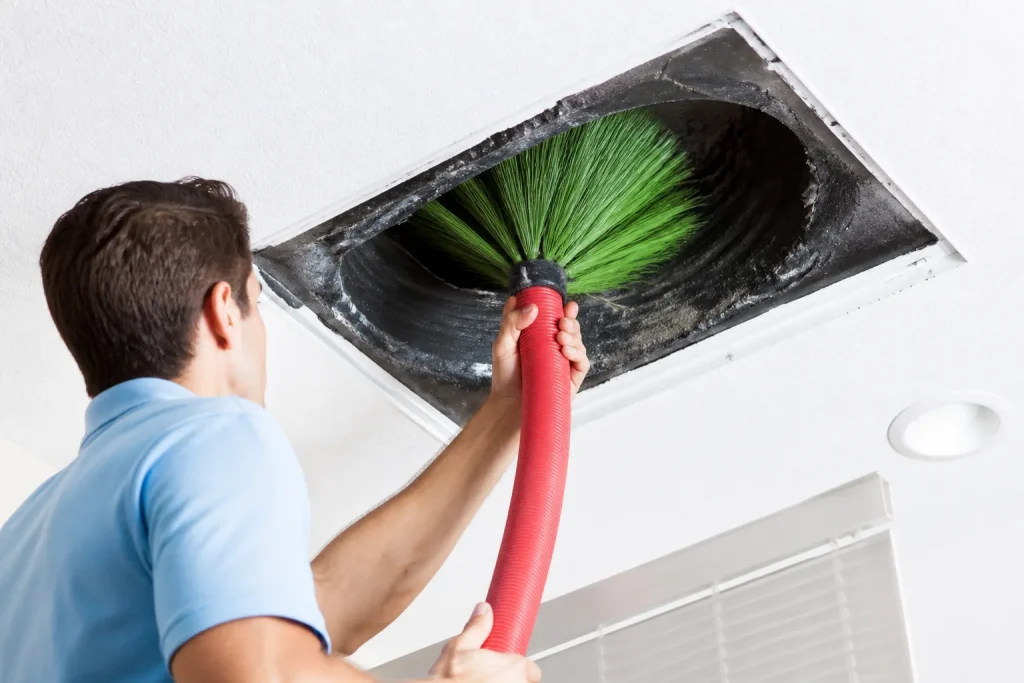
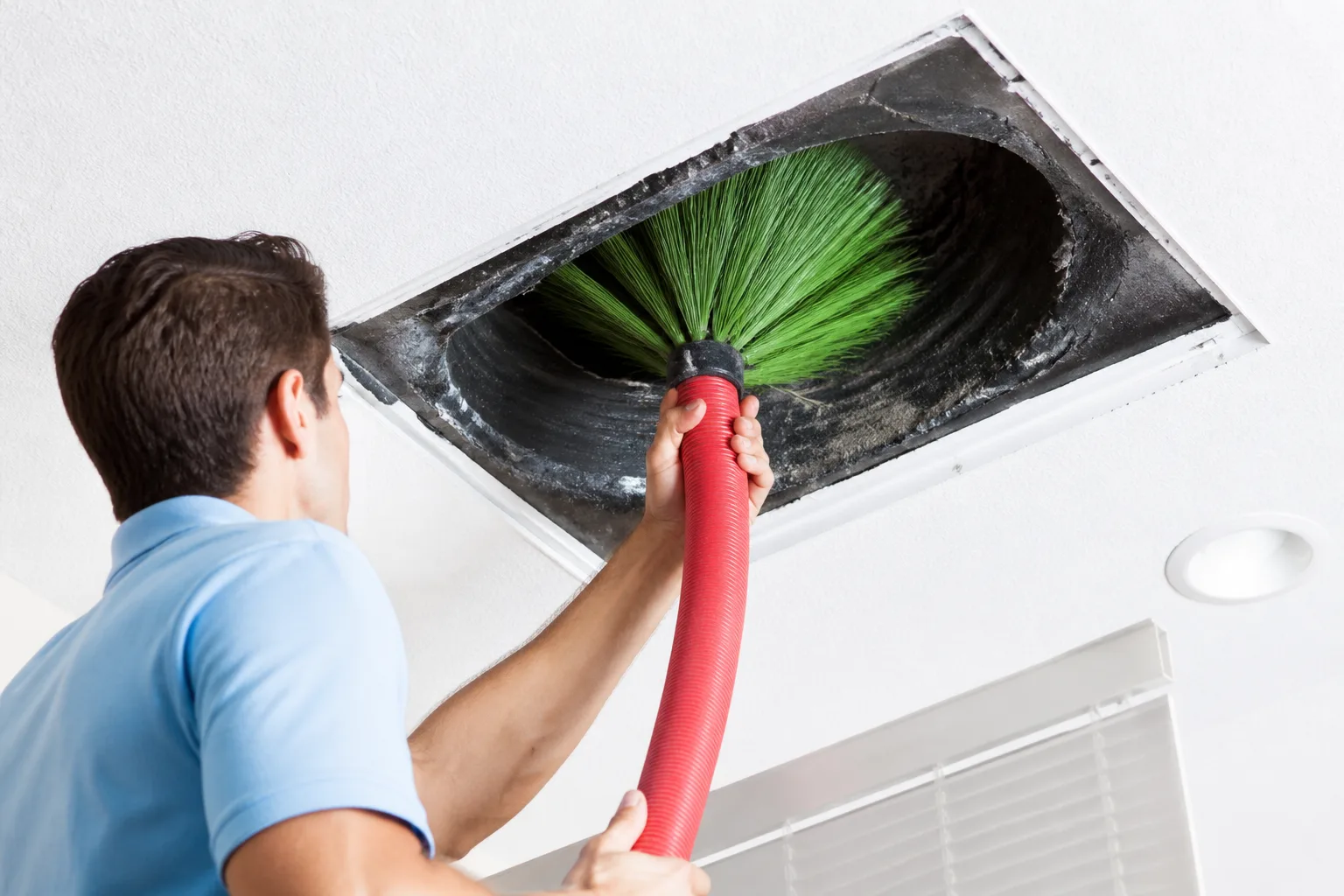
This is exactly why air duct cleaning should start with a diagnosis, not a vacuum. A technician running professional-grade equipment from Rotobrush and Nikro will tell you whether the restriction is debris, a failed seal, or a component issue. When it’s the seals, HVAC cleaning and duct sealing address the root cause instead of cleaning around it.
What do the different types of duct contamination tell you?
What’s inside your ducts has a signature, and reading it correctly points to the right remedy. A general dust coating, black streaking, and fibrous residue each mean something different. Knowing which you’re looking at helps you ask better questions before anyone sets foot in the house.
- Uniform gray dust buildup. The most common pattern and the least alarming. It’s ordinary household particulate that’s accumulated over time. Cleaning restores airflow; sealing keeps it from coming back fast.
- Black streaking near registers or on the coil. Black streaking can indicate soot, and in a damp system it can indicate microbial growth. This is not a judgment call to make over the phone. It calls for an in-person look at moisture levels and filtration before anyone starts cleaning.
- Fibrous or lint-like material. Usually tells you something upstream is shedding: a degrading flex duct liner, a loose filter, or construction debris left from a remodel. Source it before you clean it.
- Visible debris that falls out when the system runs. A late-stage sign. It means the load has exceeded what the duct can hold.
Abatement Technologies negative-air and HEPA filtration equipment is the standard we use for work around contamination, because it captures what the cleaning process liberates rather than redistributing it into the room.
Why Lakewood and the Front Range contaminate ducts faster
Ducts in Lakewood collect debris faster than the national average, and the reasons are geographic. The combination of a dry climate, high wind events, and increasingly long wildfire smoke seasons in the Front Range puts more particulate into the air and into the return side of your system than a typical East Coast or Midwest home ever sees. Add the seasonal cycles of canyon wind and the smoke that drifts down across the metro during fire season, and the accumulation curve steepens.
What that means in practice:
- Return-side filters in a Lakewood home tend to load faster than the manufacturer’s stated interval, especially during a smoke event. Check them more often than the box says.
- The dry climate means the same dust stays airborne longer and settles deeper into duct runs.
- Smoke particulate is fine enough to slip past standard filters, which is one reason homeowners here notice that musty smell or light haze on surfaces long after the fires are out.
This is also why we pair cleaning with filtration products from Honeywell and Aprilaire: the right media filter or whole-home air cleaner extends the period between cleanings, and in a smoke season that gap is measurable.
How to do a basic self-inspection before you call
A five-minute flashlight inspection tells you a surprising amount. You’re looking for what you shouldn’t be able to see. A healthy duct, viewed with a flashlight through a register, is mostly empty with a light, even dust film. Anything else is a reason to call.
- Pop a supply register off and shine a flashlight down the run. You should see a fairly clean interior with even, non-clumped dust.
- Look at the return grille for a heavy lint mat. A return that’s heavily loaded means the filter isn’t catching what’s coming through.
- Check around the blower compartment and filter slot for gaps. A leaky return pulls attic or crawlspace air straight into the system.
- Look for black, greasy, or fuzzy growth you can’t explain. Don’t wipe it and don’t disturb it. Note where it is and stop there.
- Check the dryer vent exterior flapper. If it doesn’t move freely when the dryer runs, that’s a separate and serious issue.
What you shouldn’t try to inspect yourself: the inside of the plenum, the evaporator coil, or anything reached by removing sealed panels. Those require shutting down the system, and a coil that looks fine to a flashlight can be packed with debris on the air-side surface. Our technicians have up to 11 years of experience reading exactly those areas.
When to call a pro: if you see fibrous shedding, unexplained black growth, moisture inside a duct run, or debris that falls out when the system runs, stop the DIY inspection and have it looked at. Those cases need proper containment and filtration, not a shop vac.
What about dryer vents?
A dryer vent that’s packed with lint is one of the leading causes of residential fires, and it doesn’t announce itself with dust on your vents. The signs are subtler: clothes taking a second cycle to dry, a dryer that feels hot to the touch, a flapper outside that never seems to open. If you’re already having your ducts looked at, dryer vent cleaning is a sensible add-on and one fewer system to worry about.
Related services in Lakewood: Lakewood Air Duct Cleaning Co covers air ducts, dryer vents, and HVAC cleaning under one roof, along with duct repair and sealing and post-clean sanitizing.
Does my home fail the flashlight test?
We answer the flashlight question honestly, and we treat a clean bill of health as a perfectly good outcome. The most common reason a homeowner calls is a symptom that turns out to be a filter or a damper, and we’d rather tell you that than sell you a cleaning you didn’t need.
The Bottom Line
The signs of dirty ducts arrive in stages. The early ones hide in your HVAC performance: uneven temperatures, creeping bills, fast-loading filters. Visible dust on the register is a late-stage signal, and by then the buildup is years old. Lakewood’s dry air, wind, and wildfire smoke seasons accelerate the whole timeline, so a home here accumulates faster than a national average would suggest. If the symptoms line up and your flashlight inspection turns up anything unusual, that’s the moment to call.
If you’re in Lakewood and need help, Lakewood Air Duct Cleaning Co offers free estimates. Call (877) 820-8391. We answer 24/7. Fast dispatch from 7am to 7pm, Sunday through Friday. We clean it, seal it, and test it, with professional-grade equipment and a flat price per system agreed before work starts.
Frequently Asked Questions
Most homes need it every three to five years, but Lakewood homes tend to sit at the shorter end of that range because of the dry climate, wind, and wildfire smoke seasons. Homes with pets, recent remodels, or a smoker indoors should have the system checked more often. Call (877) 820-8391 for an exact recommendation based on your system.
Low quotes often cover a surface pass at the registers rather than the full duct system, or they add charges once a technician is on site. We quote one flat price per system and agree on it before work starts, with before-and-after photos of your own ducts so you know exactly what was done. Call (877) 820-8391 for a straight estimate.
Checking the filter is a smart first step and it rules out one common cause of weak airflow. If a fresh filter doesn’t fix uneven temperatures or a musty smell, the duct system needs an inspection. Call (877) 820-8391 and we’ll help you figure out which.
Ask for before-and-after photos of your own ductwork, not stock images, and ask what equipment will be used. We use Rotobrush rotary-brush systems and Nikro high-capture units, and we document the cleaning so you can see the difference. Call (877) 820-8391 for a free estimate.
Written by the team at Lakewood Air Duct Cleaning Co.
Need Air Duct Cleaning Help?
Call Lakewood Air Duct Cleaning Co - the local pro we connect you with is licensed and insured, here with fast help in Lakewood.
(877) 820-8391